Industrial Operator by CleverdistIndustrial Operator by Cleverdist
Product
  • Protect Dispatch Window
  • Confirm True Readiness
  • Orchestrate Flexibility
  • Recover Line Speed
  • Catch Process Drift
  • Recover Hidden Capacity
  • Catch Transfer Losses
  • Keep Cranes Moving
  • Prevent HVAC Recovery
  • Clear Weak Assets
PricingQ&AAbout
info@cleverdist.com

Industrial Operator

Autonomous AI for industrial operations.

Supervised or Autonomous
On top of existing systems
Built-in governance

IO in the real world

References

Supporting multi-plant combined-cycle operations with IO
Naturgy logo

Naturgy + IO

Supporting multi-plant combined-cycle operations with IO

Centralized operations across combined-cycle power plants, with IO reasoning above existing plant systems.

11combined-cycle sites
17gas turbine units
10-25%hidden capacity identified
+5-15%throughput gain potential
€1.3Min avoided investment
€700k-€1Mannual value potential
10M+I/O parameters
50+More than 50-country collaboration
AllMultilingual shifter support
70%up to 70% fewer expert escalations

Deployed in real industrial environments — not demos. Built on 10+ years of mission-critical automation expertise.

Swiss-tech
Industrial-grade engineering
Vendor-agnostic

Differentiation

We model thinking,
not tasks.

Others chain AI agents in workflows. IO captures how your experts actually reason. That's why it scales where others don't.

Others: Linear Workflow
IO: Industrial Reasoning
STEP 01STEP 02STEP 03
Read our technical approach (PDF)

Governance & Accountability

Your pace. Your policies.

Governance that scales with confidence. Some teams need human-in-the-loop today. Others are ready for delegated execution. IO supports both, with explicit policies, full audit trails, and the flexibility to evolve at your pace.
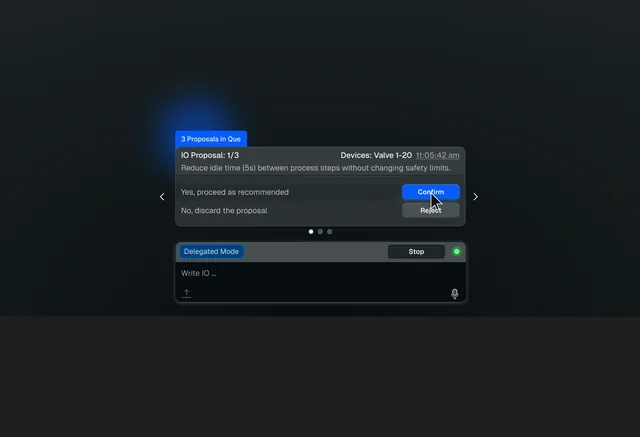
IO proposal queue — human confirms or rejects each recommendation before execution

Human in the loop

AI thinks. You decide.

Full visibility at all times. IO surfaces recommendations — every action requires a human to approve before anything happens.
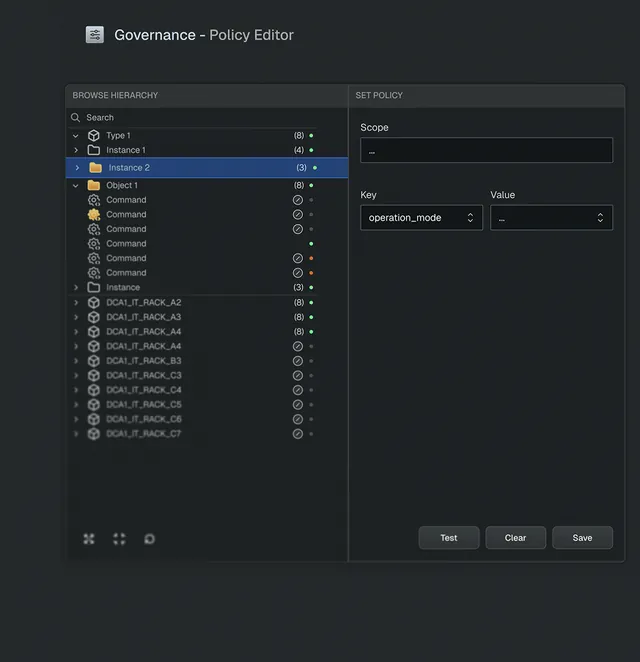
Governance policy editor — browse hierarchy and set scoped policies for delegated execution

Delegated Execution

AI acts within your rules.

Delegation is explicit, scoped, and reversible. You define what IO may or may not do — and responsibility always remains human-owned.

  • AI cannot decide or act
  • Every action remains human-validated
  • Full audit trail for regulators
  • Delegation is explicit, scoped, reversible
  • Your rules define what AI may or may not do
  • Responsibility remains human-owned

Architecture

The journey with us is simple.

We model your landscape.

Messy is fine. Our onboarding tools create the context (ontology) AI needs. We work directly with you or with your trusted integrators.

Seamless integration across your ecosystem
SCADA / DCS
Historians
MES
ERP
EAM / CMMS
APM
Quality / LIMS
Planning / APS
Documents
APIs

Examples include

SiemensWinCC OAIgnitionAVEVAABB 800xADeltaVHoneywell ExperionYokogawa CENTUM VPFactoryTalkGE ProficyPI SystemSAPIBM MaximoServiceNow...and more
Download IO Secure Architecture (PDF)

Ready?

Start your pilot.

One mission. Clear success metric. Governed rollout.

Book an intro
IOby Cleverdist

Autonomous AI that operates within your governance, at any scale.

info@cleverdist.comLinkedIn

Product

Company

AboutQ&AContact

Legal

© 2026 Cleverdist SA · Geneva, Switzerland

Use Alt with the left or right arrow keys to move to the previous or next use case in the carousel.

IO Use Cases

Energy

Protect Dispatch WindowConfirm True ReadinessOrchestrate Flexibility

Manufacturing

Recover Line SpeedCatch Process DriftRecover Hidden Capacity

Logistics

Catch Transfer LossesKeep Cranes Moving

Mobility

Prevent HVAC RecoveryClear Weak Assets

Manufacturing · Workshop Production

Recover hidden workshop capacity before new equipment is needed

IO reasons across waiting time, work-center imbalance, sequencing and setups to show where usable production capacity is leaking between operations, not inside breakdown events.

Relevant for discrete manufacturing and workshop production where throughput is limited less by breakdowns than by waiting, imbalance, sequencing, setup frequency and coordination losses across machines or work centers.

10-25%hidden capacity identified
+5-15%throughput gain potential
EUR 1.3Mavoided investment
EUR 700k-1Mannual value potential

Use case context

The machines are running, but capacity is leaking between operations

In discrete manufacturing, performance losses often do not look like classic downtime. A machine can be technically available while the workshop still misses output targets.

Waiting, uneven loading, sequencing friction and setup frequency consume productive time in small dispersed events.

By the time output is below target, the loss is already fragmented across many machines, routings, orders and work-center decisions.

IO turns this into a mission: expose the losses between operations, explain which mechanisms matter most, and recover usable capacity before adding equipment.

Concrete trigger

A workshop shows high machine uptime, yet output remains below target because waiting between operations, uneven work-center loading, frequent setups and sequencing decisions consume usable machine time.

Pain points

What it costs when capacity is lost between machines rather than inside them

The issue is not only machine downtime. Usable capacity can disappear in waiting time, routing choices and setup patterns that are too fragmented to appear as one clear loss.

Visible production loss

  • Machines wait despite available demand.
  • Comparable machines or work centers are unevenly loaded.
  • Setups occur too frequently for the production mix being run.

Hidden coordination loss

  • Sequencing decisions destroy usable capacity without triggering major downtime alarms.
  • Setup time eats directly into productive machine time.
  • Losses remain invisible in high-level KPIs because they are dispersed across many small events.

Capex pressure arrives too early

  • The plant appears capacity-constrained before existing capacity is fully recovered.
  • Improvement work chases visible bottlenecks while distributed losses continue.
  • Investment decisions are made without a clear view of recoverable machine time.

How IO reasons

IO models the planner and supervisor who see where usable machine time is really leaking away

This mission is not uptime reporting. IO reasons across machines, routings, orders, setup patterns and work-center load to identify where coordination losses consume capacity.

Finds idle capacity

IO identifies waiting patterns across machines and explains why they occur instead of treating idle time as background noise.

Explains imbalance

IO highlights uneven workload distribution across comparable machines or work centers and shows how that imbalance limits total throughput.

Quantifies sequencing cost

IO shows how work-order sequencing creates extra setups and lost production time that the plant may have accepted as normal.

Connects capacity loss to decisions

IO links lost machine time to the planning, routing, labor or setup choices that can actually be changed.

IO governance

The user decides how much authority IO has

Capacity recovery can start as supervised decision support, then move toward governed follow-through once sequencing, balancing and scheduling boundaries are defined.

Default mode: IO reveals recoverable capacity, production leadership decides the changes

  • Detect: IO identifies capacity-loss patterns across waiting, balancing, sequencing and setup time.
  • Frame: IO explains where productive machine time is being consumed and which mechanisms matter most.
  • Validate: supervisors and planners confirm which changes are operationally realistic without destabilizing commitments.
  • Act: approved sequencing, balancing, setup or scheduling adjustments are executed.

This mission may remain human-validated because capacity recovery often involves trade-offs between planning, labor, setup stability and delivery commitments.

Delegated mode: IO follows approved capacity-recovery rules

  • Recommend sequencing changes that remove unnecessary setups and idle time.
  • Suggest balancing actions across comparable machines or work centers.
  • Highlight the bottlenecks creating the largest immediate capacity loss.
  • Trigger scheduling adjustments around validated loss patterns.
Governed follow-through
  • Keep delivery-impacting changes planner-approved unless explicitly authorised.
  • Apply only approved sequencing or balancing rules inside defined product, resource and time-window boundaries.
  • Prioritise high-impact capacity recovery before lower-value improvement work.
  • Track whether implemented changes truly recover usable capacity.

Expected benefits

More output from the same machine set before more equipment is added

Expected value depends on current demand, machine mix, routing flexibility, setup frequency, labor constraints and how much planning follow-through can be governed.

More throughput

Higher output without new equipment by recovering productive time already present in the installed machine set.

Better utilisation

Machines are used closer to their true effective capacity instead of being constrained by coordination losses.

Clearer investment timing

Separate real capacity limits from recoverable coordination losses before committing to new equipment.

Less wasted machine time

Reduce setup and waiting losses in ways that directly improve usable capacity, not just reporting.

Discuss this case

Is your capacity really limited by machines, or by coordination?

This use case is relevant when the plant appears capacity-constrained, but missing output may actually be lost between operations through waiting, imbalance, sequencing and setup friction.

  • Where do theoretical and actual machine capacity diverge most strongly?
  • How are waiting, setup and sequencing losses measured today?
  • Which comparable machines or work centers are unevenly loaded?
  • Which setup patterns or order sequences consume the most productive time?
  • Which capacity-recovery actions must remain planner- or supervisor-approved?
  • Which avoided capex, throughput gain or annual value target would justify the first mission?

Want to map where usable machine time is leaking across your workshop?

info@cleverdist.comLinkedIn