
How many rules have you added to a problem that still needs an expert every time it happens?
01 / WHEN RULES NEED INVESTIGATION
Consider a packaging line with recurring unplanned stops. The alarms capture each event, but finding the cause still means comparing trends, checking maintenance records, comparing production runs and reading operator notes. The automation has detected the event, while the investigation still depends on someone who knows how to interpret it.
Another rule may help if you already know what to look for and how to respond. But if an engineer must first investigate what happened and why, the problem needs reasoning. That distinction helps teams decide when to add a rule and when they need a different approach.

Rules can handle context too
Rules can account for context, such as alarm conditions for start-up and steady operation, but when a line stops for an unclear reason, an engineer must investigate first before deciding whether another rule would help.
When another rule stops reducing the work
An expanding rule set is not automatically a problem. It may reflect new operating modes, better process knowledge, or lessons from previous incidents. The useful question is what happens after each addition. Does the new logic resolve a recurring decision, or does it produce another alert that an expert must interpret?
If operators keep adding qualifications to recommendations, the system may be missing essential context. If each incident requires a different combination of records and checks, adding more conditions may do little to reduce the investigation. Engineers then have more logic to maintain while the difficult decisions still land on their desks.
02 / EVIDENCE AND EXPERT JUDGMENT
Follow the investigation on a packaging line
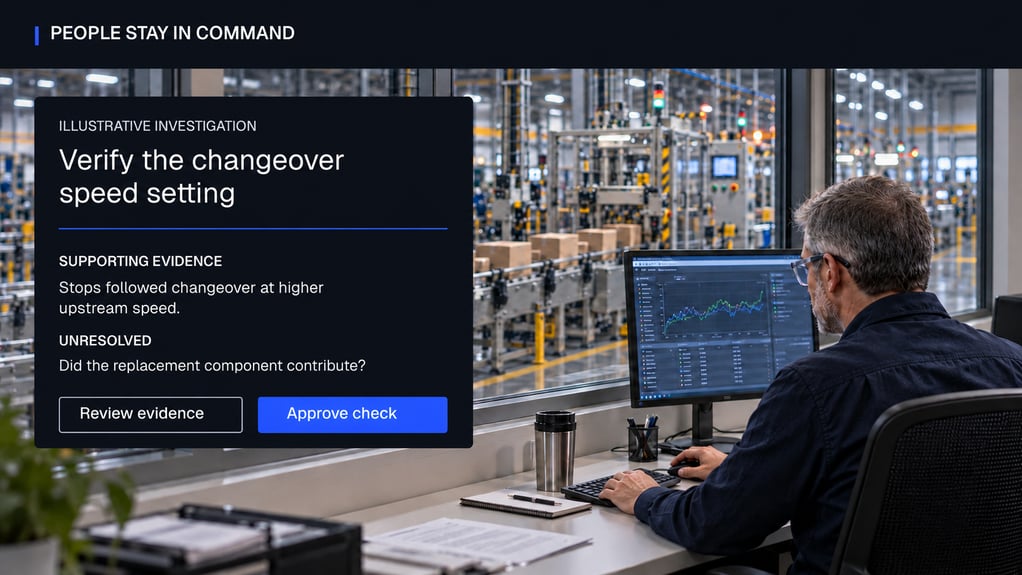
On the hypothetical packaging line, stops tend to follow a product changeover when an upstream unit runs at higher speed. A component was recently replaced, but timing alone does not establish the cause. The engineer needs to check whether the replacement, a changed setting, or the operating conditions explain the stops.
Comparing failed runs with successful ones helps test those explanations. Did the line run normally under the same conditions after the replacement? Did similar stops happen before maintenance? Operator notes may reveal an adjustment worth checking.
Each finding guides the next check. Once the cause is understood, the solution may become a rule, an updated procedure, or a permanent correction. Reaching that point takes expert judgment, and the specialists who provide it have limited time.
A useful recommendation must be open to challenge
A reasoning system supporting that investigation should give an engineer more than a likely cause. It should show the supporting records, explain their relevance, and identify what remains unresolved. A recommendation to inspect the replacement component, for example, should include the timing and operating conditions behind it. It should also acknowledge comparable runs that do not fit the explanation.
This gives the expert something concrete to assess. They can question an assumption, identify missing information, or decide that a different check would be more useful. Sometimes the appropriate next step is another measurement; sometimes the evidence supports escalation rather than a diagnosis. Recognising those limits is part of useful reasoning.
03 / A DEFINED MISSION. A MEASURABLE RESULT.
Give reasoning a defined job
Start with a recurring problem and its measurable cost, such as the expert time spent investigating each line stop. Define the needed information, the decisions to support, and the available actions. This gives the team a clear scope to evaluate against its current process.
IO, short for Industrial Operator, is Cleverdist’s Autonomous Reasoning System. It works above existing industrial systems, continuously gathering context and evaluating options around a defined mission. On the packaging line, that mission could be to reduce investigation time by connecting historian data, alarms, maintenance records, and production information.
Existing controls keep their responsibilities. Integration and data preparation provide the context for reasoning, while permissions, approval requirements, and escalation rules govern action. A mission can start with human-reviewed recommendations and progress to delegated execution only where explicitly authorised.
Measure whether the investigation improves
Set a baseline using expert hours per incident, time to a supported diagnosis, and time to an approved response. Measure quality as well as speed: recommendations should hold up when records are missing, signals conflict, or several explanations seem plausible.
Use deterministic automation when you can define conditions and responses in advance. Use reasoning when deciding what matters and testing explanations are part of the work. Start with one recurring problem and measure whether it reduces expert workload and improves the operational outcome.
Bring us one problem that repeatedly sends your experts back through trends, logs, and maintenance records. We can help define an IO mission around the investigation, the permitted actions, and a measurable output worth pursuing.